












































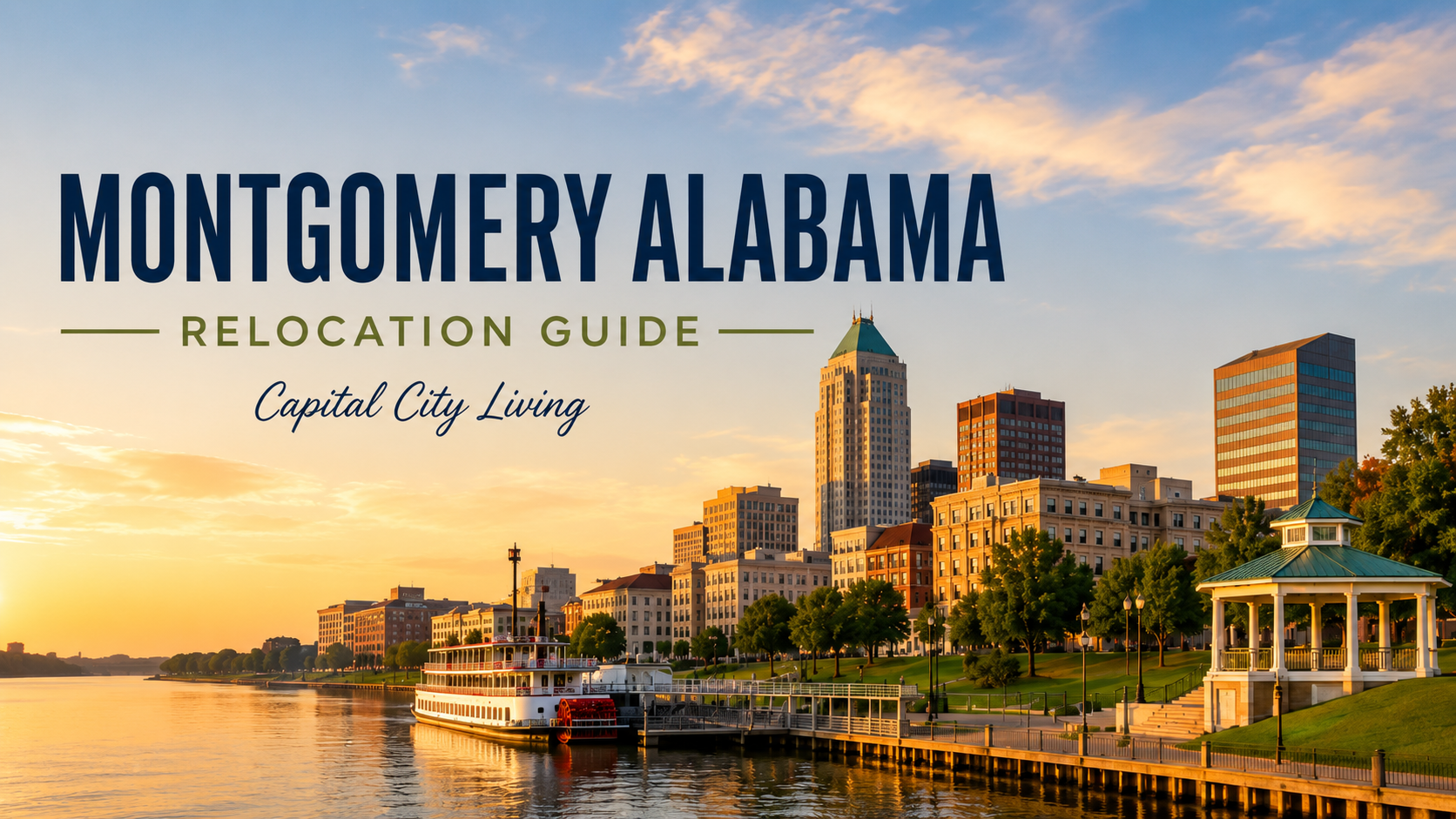
Montgomery, Alabama combines state-government careers, military connections, historic neighborhoods, universities, and riverfront recreation. Located in central Alabama, the city serves as the state capital and the center of the River Region.
Known for its Civil Rights history, Montgomery also supports manufacturing, healthcare, logistics, education, and professional services. Additionally, downtown offers museums, restaurants, baseball, events, and Alabama River views.
The city’s estimated population reached 195,300 in 2025. Whether you are moving for work, family, education, or lifestyle, this Montgomery Alabama Relocation Guide explains the essentials.
Montgomery sits in central Alabama along the Alabama River. The city is approximately 90 miles south of Birmingham and about 160 miles southwest of Atlanta.
Interstate 65 connects Montgomery with Birmingham and Mobile. Meanwhile, Interstate 85 provides access toward Auburn and Georgia.
Montgomery belongs to the Central Alabama region.
Additionally, the city is commonly associated with:
Because of its location, residents can reach Birmingham, Auburn, Mobile, and several smaller communities by highway.
Montgomery is close to Prattville, Millbrook, Wetumpka, Pike Road, Hope Hull, Coosada, and Tallassee.
These communities provide additional housing, school, and shopping choices. However, commute times depend on workplace location and daily traffic.
Montgomery attracts government employees, military families, healthcare workers, manufacturers, students, and logistics professionals.
Additionally, the city offers varied housing, established neighborhoods, colleges, museums, and regional employers. As a result, newcomers can combine career opportunities with a manageable city lifestyle.
Montgomery offers apartments, townhomes, historic houses, suburban homes, and newer developments. Housing expenses vary by neighborhood, property condition, and commute.
Everyday costs include transportation, electricity, groceries, insurance, healthcare, and property taxes. Still, many residents find Montgomery more affordable than larger Southern metropolitan areas.
Montgomery’s housing market includes historic districts, suburban subdivisions, downtown apartments, and larger properties near the city’s eastern side.
Because conditions vary by area, buyers should review drainage, taxes, school assignments, and commute routes before purchasing.
Downtown offers apartments, lofts, historic buildings, and renovated residential properties. Residents can reach offices, museums, restaurants, Riverfront Park, and Riverwalk Stadium.
Additionally, the district hosts concerts, festivals, markets, baseball games, and cultural events. The downtown riverfront combines public spaces with dining, entertainment, and historic attractions.
Cloverdale features historic homes, apartments, mature trees, parks, and neighborhood businesses. Because of its central location, residents can reach downtown and several colleges quickly.
Restaurants, theaters, and local shops add convenience. However, older properties may require additional maintenance.
Capitol Heights sits northeast of downtown and includes cottages, bungalows, and historic homes.
The neighborhood appeals to residents seeking architectural character and central access. Therefore, buyers should compare renovations, property conditions, and surrounding blocks carefully.
Dalraida offers established residential streets, brick homes, parks, and access to northern Montgomery.
Additionally, the neighborhood provides convenient routes toward downtown, Gunter Annex, and nearby shopping areas. Many properties offer a traditional suburban setting.
East Montgomery contains newer subdivisions, apartments, shopping centers, offices, and expanding residential development.
Popular areas near Taylor Road, Vaughn Road, and Chantilly Parkway provide access to retail and services. However, traffic can increase during commuting and shopping hours.
Pike Road sits east of Montgomery and continues attracting residential growth.
The community includes newer subdivisions, larger homes, and planned developments. Meanwhile, commuters can reach eastern Montgomery employers through Interstate 85 and connecting roads.
Prattville and Millbrook lie north of Montgomery in Autauga and Elmore counties.
These communities offer suburban neighborhoods, apartments, shopping, parks, and separate school systems. However, Interstate 65 traffic may affect daily commuting.
Montgomery’s economy includes government, military operations, healthcare, manufacturing, logistics, education, and professional services.
Additionally, recent regional development has focused on advanced manufacturing, automotive supply chains, technology, logistics, and distribution.
As Alabama’s capital, Montgomery supports numerous state agencies, courts, administrative offices, and public-service organizations.
Related careers include:
Therefore, government remains a major part of the local employment market.
Maxwell Air Force Base and Gunter Annex support military, civilian, education, technology, and contractor employment.
Military families often relocate to Montgomery for assignments and professional training. Additionally, nearby neighborhoods provide access to both installations.
Manufacturing remains a major regional industry.
Local and regional employers support:
The Montgomery Chamber also lists logistics, utilities, manufacturing, customer support, and distribution among important employment categories.
Healthcare employers include hospitals, medical practices, rehabilitation centers, pharmacies, and senior-care providers.
As a result, residents can find careers in nursing, medical administration, therapy, diagnostics, and patient support.
Education employers include:
Together, these institutions support teaching, research, administration, maintenance, and student services.
Most public school students within the city attend Montgomery Public Schools.
Families should confirm attendance zones and enrollment requirements before choosing a home. Additionally, magnet programs use applications, limited capacity, and selection processes.
Montgomery Public Schools operates elementary, middle, and high school programs across the district.
Current improvement efforts focus on expanding student opportunities and strengthening academic programs. Therefore, families should compare individual schools, specialized programs, transportation, and enrollment requirements.
Montgomery also offers private, religious, independent, and specialized schools.
Admissions, tuition, transportation, and grade availability differ by institution. Consequently, families should contact each school directly.
Major higher education options include:
These institutions provide business, education, healthcare, law, technical, liberal arts, and professional programs.
Montgomery serves as a regional healthcare center for central Alabama.
Residents can access primary care, pediatric treatment, emergency medicine, specialty clinics, rehabilitation, and senior services. Additionally, medical facilities are located throughout central and eastern Montgomery.
Montgomery offers national retailers, shopping centers, neighborhood businesses, markets, and independent stores.
Major commercial areas include:
Because shopping districts are spread across the city, personal transportation remains helpful.
Montgomery’s dining scene includes Southern cooking, barbecue, seafood, international cuisine, cafés, bakeries, and family restaurants.
Downtown and Cloverdale provide several concentrated dining options. Meanwhile, East Montgomery offers national restaurants and newer local businesses.
Montgomery supports museums, theaters, live music, festivals, sports, and community events.
The Alabama Shakespeare Festival presents professional productions throughout the year. Additionally, Riverwalk Stadium hosts Montgomery Biscuits baseball and other events.
Montgomery offers museums, historic sites, parks, outdoor attractions, and family entertainment.
Its role in American history creates numerous educational opportunities. Meanwhile, the growing riverfront provides recreation and community gathering spaces.
Montgomery played a central role in the American Civil Rights Movement.
Important sites include:
The Equal Justice Initiative also operates Freedom Monument Sculpture Park along the Alabama River.
Riverfront Park provides Alabama River views, walking areas, event space, and access to Riverwalk Stadium.
Residents can attend concerts, festivals, baseball games, and seasonal activities. Furthermore, downtown restaurants and museums sit nearby.
The Montgomery Zoo offers animal exhibits, educational programs, family events, and outdoor activities.
Its attractions also include the Mann Wildlife Learning Museum. Therefore, it remains a popular destination for families.
Montgomery Whitewater provides outdoor recreation near the city.
Activities may include rafting, kayaking, climbing, walking, and community events. Additionally, the attraction expands recreational choices beyond traditional parks.
Montgomery maintains neighborhood parks, trails, sports fields, playgrounds, and recreation facilities.
Residents can also explore:
The city’s open-data resources provide information about park locations, trails, and available amenities.
Montgomery remains primarily car-dependent.
Major routes include:
Traffic may increase near downtown, Maxwell Air Force Base, EastChase, and major interstate interchanges. Therefore, home location can strongly affect daily travel.
The Montgomery Area Transit System provides bus transportation along selected routes.
However, service remains more limited than transit systems in larger metropolitan areas. The city provides route and transit information through its official transportation resources.
Montgomery Regional Airport sits southwest of downtown.
The airport provides access to connecting airline hubs. Meanwhile, Birmingham-Shuttlesworth International Airport offers additional flight choices within driving distance.
Montgomery has a humid subtropical climate.
Summers are hot and humid, while winters are generally mild. Meanwhile, spring and fall often bring comfortable outdoor temperatures.
Central Alabama can experience thunderstorms, tornadoes, hail, flash flooding, and strong winds.
Therefore, residents should follow reliable weather alerts during severe conditions. Property buyers should also review drainage and flood information for each address.
Montgomery can be a practical choice for government workers, military families, manufacturers, healthcare professionals, students, and retirees.
The city combines employment opportunities with historic neighborhoods, universities, cultural attractions, and riverfront recreation. Additionally, nearby suburbs provide more housing and school choices.
However, neighborhood selection remains important. Commutes, school assignments, housing conditions, and amenities vary throughout the region.
Montgomery offers a balanced combination of government careers, military connections, education, history, and recreation.
Manufacturing and healthcare provide additional employment choices. Meanwhile, downtown attractions and riverfront development continue expanding the local lifestyle.
For newcomers seeking opportunity within Alabama’s capital city, Montgomery deserves serious consideration.